Jaroslaw Kessler,
Moscow, Russia
(Proceedings of the 2nd International Meeting
A Revised Chronology and Alternative History,
Rüspe, Germany, June, 2001)
CIVILIZING EVENTS AND CHRONOLOGY
On the cosmic scale of time our civilization is very young. Conventionally it has been lasting about 8-10 thousand years since the beginning of the neolithic age. At that time homo sapiens (human beings) supplanted homo habilis (pre-human primates). Essentially, our civilization is the age of production. There are two necessary conditions to be fulfilled for any producing activity: 1) some natural resource must be available, and 2) a certain technolology must exist. Nature itself provides all resources, but any technology must be invented. An invention stems from a certain discovery, when à man reveals a new law of nature or a new kind of a natural resource.
The sequence discovery - invention - new technology - new anthropogenic production constitutes a civilizing event providing a new product or a new level of production for a user.
Thus, civilization presents a wave-like process: evolutional periods (replication and reproduction of goods by means of conventional technology and experience) alternate with revolutional ones (when a certain technological burst takes place). Here the term technological burst is applied not only to engineering and manufacturing but also to culture, i.e. art, music and any other humane activity. So, in the widest sense, the term civilizing event seems to be more appropriate than the technological revolution when applied to a sharp rise of civilization upon a higher level.
Each civilizing event (CE) is put into effect within its own interval of realization (RI). RI of a given CE can be defined as the while between the appearance of a new product (in the widest sense) or some well-known product by means of a new method, and the beginning of its mass consumption, rising our civilization upon a new, qualitativly advanced level. The latter corresponds to a moment when the number of consumers exceeds the percolation threshold for a 3-dimentional infinite cluster. Every new-born infinite cluster of human beings designates the creation of a new community of more civilized users. In a random system this threshold is equal to 1/6. For example, as far as the current population amounts to 6 billions, CE called the world-wide Internet came into being as soon as a number of Internet users exceeded 1 billion. One can see that even the larger part of the mankind may not belong to the new more civilized community. Some part of the population can stay on much lower levels, e. g. certain aboriginal tribes in South America, New Zealand or Central Africa.
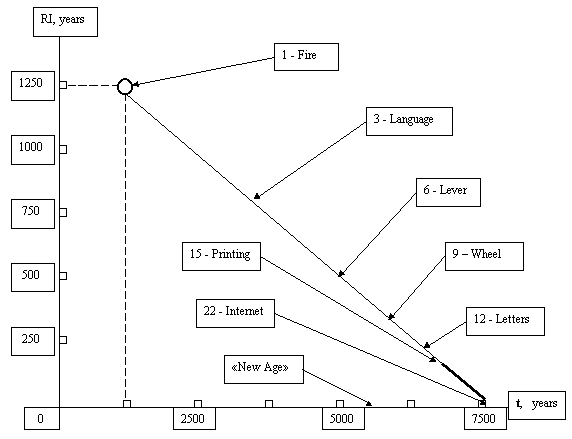
Some most important civilization events are summarized in Table 1. Since ca. 1500 A. D. (stages 15-22 in
- if any two civilizing events come to being at the same time, their RIs are equal;
- if one civilizing event takes place after another, the RI of the former is less than that of the latter.
The first conclusion reflects the fact that each epoch can be characterized by its own rate of civilizing. The second one stems from ramifying of CEs consequences and synergetics of simultaneous CEs. For example, artillery and printing are the CEs of the XV century and their RIs are evaluated as about 100 years. At the beginning of the XIX century RIs of steam-engine, vaccination and musical chromatic scale amounted to 40 years. At the beginning of the XX century RIs of current generator, radio and telephone etc. were already close to 20 years and so on.
One can see that within the historically well-dated term since 1500 A. D. there are no breaks of civilization inspite of all wars, epidemic diseases etc. Neither are there any experimental data to surmise such breaks in the past since the Deluge. Analysis of more than 50 CEs since 1400 A.D. leads to a simple RI dependence on time t:
RI (years, ± 20%) = 1500 - 0.2 t
Here t is the time since a certain start of civilization t0. This equation presents a decreasing arithmethical progression and may be called an equation of civilization rate. This rate is constantly accelerating while each century RI is decreasing by 20 years.
In order to define t0 one must fix the first step (the first stage of civilization) and evaluate the number of consecutive steps from the beginning up to nowadays. As the first step one can accept fire-sustaining. This is a genetical leap separating a human being from an animal which is genetically tabooed by fire. At this first step RI (1) = t1 (see Fig. 1). The number of consecutive steps can be estimated by means of formal logics based on causal relationship of CEs. As shown in Table 1 and seen from Fig. 1, the number of interpolated consecutive steps until 1500 A.D. amounts to 14 only (± 2). From this the current age of human civilization can be estimated as 7500 ± 2500 years. It is consistent both with the neolithic age and with the Byzantine Age of Creation.
Study of consecutive steps (stages of CE) is a powerful method to define the right (not a certain new!) chronology. For example, cavalry and horse-driven transport could not physically exist in Western Europe until the XIII century because until then there had been neither natural, nor artificially-created conditions for horse-keeping in this area, contrary to steppe areas. Judging even from traditional references, at the beginning of the XII century in Italy or France a horse was extremely expensive - about $30000 if recalculated. Both in Germany and Russia the largest penalty - Wergelt - ought to be paid not for the murder of a free man or treason but for horse-stealing. William the Conquerer gathered only about half a thousand mercenaries mounted on horses out of the whole Western Europe and nevertheless he won the Battle of Hastings, because opposing Haralds troops, numbering more than 5000 soldiers, were on foot. And no cavalry could exist had not harness technology been developed before, no armoured free lance mounted on a horse could fight without stirrups etc.
No good iron could be manufactured before cox-coal melting technology and no iron tools like a saw or a drill could have been produced earlier. No shaved faces of grown-up men could be painted before a razor had been made - every man was bearded, i.e. he was a barbarian. No self-portrait was known until Leonardo da Vinci - and that was the time when transparent glass was manufactured at first, so first glass mirrors appeared. No careful sea maps could have been drawn by any Mercator until Sir Isaac Newton invented a sextant in 1675 A.D. and Ch. Huygens made a pendulum clock in 1657. And no ancient Codex Argenti could be written in silver Gothic letters before Dr. Johann Glauber and his works in chemistry (1648-1660 A.D.)
These examples demonstrate only a small part of results obtained by the CE method. The method was successfully applied by the author also to terminology and linguistics, basing on excellent works by É. Benveniste, a prominent French scientist of the XX century in this field.
For instance, there were no real kings in Great Britain before Henry Tudor because, particularly, preceding rulers were addressed as Your Grace or Your Serenity. Henry Tudor himself was titled as Your Highness and only his son Henry VIII became His Majesty. There is also a strong suspicion that half-Welsh Henry Tudor was a close relative of John III of Russia and that all preceding history of Britain is invented by Sir F. Bacon and Co. and promoted by the genius of Shakespear or rather Shakes-PR. On the other side the history of Russia was created by Catherine II herself and her coworkers and finally edited by Nicolaus I in the XIX century. The same holds for the history of any other European country. (The history of Germany is fictitious as well as shown, for example, by Diter Foster for the times of Martin Luther. By the way, even in the XVIII century in England the word german was not yet associated with the German people but designated a relative by blood.)
The real history of church began not earlier than in XIV century. It is enough to look through the Bible and you find out that, e.g., in the Apocalypse St. John mentioned glass transparent as crystal (Rev. 4, 6; 21, 18; 21, 21; 15, 2). And there is some revelation because technologically it corresponds to the end of the XV century as the earliest. And as St. Paul intended to visit Spain (Rom. 15, 28), it means that it could not have happened before 1479 A.D., because the word Spain appeared at that time firstly to designate the union of Castilia and Leon. Moreover, this word is neither Spanish nor Latin - it is of Balto-Slavonic origin as compared, e. g. with Czech spojeny = united.
As well the Anglo-Saxon army was called fyrd - the word corresponding to contemporary horde. Is there any difference between Anglo-Saxons of the VI century and Tartars of the XIII? There exists also an old engraving dated 1514 A.D. It demonstrates King Arthur fighting against Scosa for Paris! Thereupon Arturs army is under Swedish Tre Kronor banner and that of Scosa is under the Double Eagle!! Does not Scosa look like a Cossack?
One can see that there are more questions than answers concerning conventional history. As plainly stated in Encyclopaedia Britannica in 1771 A.D., History, with regard to subject, is divided into the history of Nature and the history of Actions. The history of Actions is a continued relation of a series of memorable events. It is quite right: conventional history is the history of Actions and made of memorable events. This history is not natural and it should rather be called political historiography.
The real history of civilization is still to be written. And it is more than probable that the New Age of our civilization started with Bethlehem Supernova blown up in Taurus on July 4, 1054 A. D. Since then the pulsar has been radiating from the core of the Crab-like nebula. It may be poetically called The Heart of Salvator.
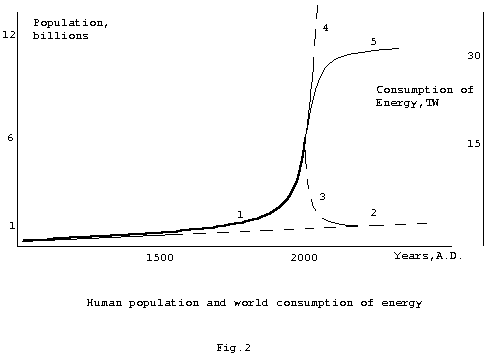
Now, if you look at Fig. 1 again, you can see that nowadays our civilization is close to its end because RI approximates to zero. The Internet is one of signs of a new-coming post-genome era. As soon as the mankind is able to change its genetics, it will unequivocally transmute into some other population and then this new population will start a new civilization of its own. A post-human being will differ from us as well as we differ from homo habilis. So we find ourselves in the vicinity of a phase transition, that is demonstrated in Fig. 2.
In Fig. 2 Curve 1 reflects current crucial changes both in human population and energy consumption, dealt with the technological revolution having been lasting since ca. 1500 A.D. Curve 2 corresponds to simple human reproduction (which does not differ from animal one) and natural fuel consumption (wood, straw, manure etc.) that had been until 1500 A.D. If there had not been any technological revolution, now the world population would amount to about 800 millions only. If nothing is done to stabilize population, Curve 4 should take place. But hardly it seems real, because the mankind has not yet found a new more powerful and simultaneously much less harmful source of energy than nuclear fission. So sooner or later Curve 4 would convert to Curve 3: this one stems from a scenario for the Caribbean nuclear war of 1962, which fortunately did not happen. If it did, the world population would drastically fall down to animal-like Curve 2. (Note, that the same curve is consistent with Golden billion calculations and speculations.) If the UNESCO forecast comes to being (Curve 5), the world post-human population will stabilize at the level of 11-12 billions in the XXI century. Thus, the mankind is trying to change the type of its own phase transition from first to second order - in order to escape an apocalypse.
Why did the phase transition of our civilization begin approximately about 1500 A. D.? It proceeded mainly from the two simultaneous civilizing events: fire-arms and printing. The first CE caused massacre of lower-civilized people and animals. Expansion of the new power lead to mass felling and destruction of flora. It started irreversable anthropogenic pressing on the environment. The second CE started politology: the technology of mass media pressing on mind. That is the point where the false conventional chronology and history comes from.
Up to this point there is no discrepancy between Fig. 1 and Fig. 2. But the peculiarity is that demographers did not admit Curve 2 before 1500 A.D. because of the false conventional chronology created by J. Scaliger in the XVI century. They have to insert a number of breaks in it: population plateaus in 200-300, 1200-1300, 1400-1500 and 1600-1650 A.D., and the Plague downfall between 1300 and 1400 A. D., when supposedly ¼ of the population died. Demographers are forced to install these breaks in order to make demography consistent with fanthom data from different ancient books. They have to evaluate the population of 50 millions at the beginning of the neolithic age - the number that is very far from archeological proofs. And by fixing simple human reproduction at the lowest possible level of 0.1% increase per year one can easily calculate down Curve 2 from 1500 A. D. (when the population consisted of ca. 440 millions people) that at the beginning of the neolithic age there was no more than half a million human beings transmuted out of homo habilis.
The right chronology is needed badly if only for one reason: the false conventional history distorts the starting parameters of the phase transition that our civilization is experiencing. This can lead to wrong prognoses pregnant with bad consequences.
Table 1
Civilizing events and their interval of realization
|
№№ stage |
Years from the "beginning" |
A.D. Years |
RI, years |
Civilizing events |
|
1 |
0-1250 |
- |
1250 |
Fire-sustaining |
|
2 |
1250-2300 |
- |
1050 |
Flint. Primitive tools. Lance. |
|
3 |
2300-3200 |
- |
900 |
Wicker-work. Skep. Drag-net. Raft. Language. |
|
4 |
3200-3900 |
- |
700 |
Bow. Lever. Sledge. Canoe. Apiary. Dog. |
|
5 |
3900-4500 |
- |
600 |
Oar. Curing by smoking. Cropping. |
|
6 |
4500-5000 |
- |
500 |
Meat cattle-breeding. Barter. Yoke, beam, balance. |
|
7 |
5000-5400 |
- |
400 |
Baking. Boiling. Unleavened bread. Winch. Wooden plough. Harvesting. Milk cattle-breeding. |
|
8 |
5400-5750 |
250 |
350 |
Millstone. Quern. Spindle. Distaff. Lye.Bucking. |
|
9 |
5750-6050 |
550 |
300 |
Wheel. Draught oxen. Boat. Thole. Tar. Red-hot melting. Brass. Forgery. Sword. |
|
10 |
6050-6300 |
800 |
250 |
Coal as reducer of metals. Iron. Cooperage. Melted ceramics. Opaque glass. Water-mill. Horse. Hieroglyphs. |
|
11 |
6300-6500 |
1000 |
200 |
Sail. Wind-mill. Xebeck. Raw leather. Sling. Horse-riding. |
|
12 |
6500-6660 |
1160 |
160 |
Letters. Harness. Belt drive. Gimlet. Pickling. |
|
13 |
6660-6800 |
1300 |
140 |
Cavalry, horse-driven cartage. Loom. White-hot melting. Damask steel. |
|
14 |
6800-6900 |
1400 |
120 |
Cement. Stone towns. Minting. Arbalest. |
|
15 |
6900-7000 |
1500 |
100 |
Powder. Paper. Printing. Transparent glass. Compass. Globe. Distillation. Alcohol. Vitriol (sulphuric acid). |
|
16 |
7100 |
1600 |
80 |
Coal as fuel. Glass-blowing. Magnifying glass. Spectacles.Gear, cog-wheel. Spring. |
|
17 |
7200 |
1700 |
60 |
Pendulum, pendulum clock. Optical navigation devices. Piston. Pump. Worm-gear. Jack. Thermometer. Rifle. |
|
18 |
7300 |
1800 |
40 |
Rolling. Steam-engine. Vaccination. Musical chromatic scale. |
|
19 |
7350 |
1850 |
30 |
Direct current. Telegraph. Photography. Railway. |
|
20 |
7400 |
1900 |
20 |
Indirect current. Electrotechnics. Welding. Radio. Phonograph. Telephone. Cinema. Oil as fuel. Nitrodyers. Dynamite. Internal-combustion motors. Automobile. Caterpillar. Tank. Aluminium as material. Aviation. Compressor. Submarine. |
|
21 |
7450 |
1950 |
10 |
Plastics. Antibiotics. Magnetic memory. TV. Nuclear weapons. Satellites. Nuclear power station. Video. |
|
22 |
7500 |
2000 |
< 5 |
Laser. PC. Internet. |
Fig. 1
Interval of CE realization (RI, years) vs. time (t, years) from the beginning of our civilization up to nowadays:
RI (± 20%) = 1500 - 0,2 t
Well-dated intervals (stages 15-22, since 1500 A. D.) are designed as the bold line. Figures designate consecutive stage numbers.
WHAT DO YOU THINK ABOUT THIS ARTICLE?